Introduction
Industrial equipment requires regular cleaning to maintain performance, prevent unexpected breakdowns, and extend service life. Over time, machinery can accumulate grease, oil, carbon deposits, paint, rust, and other stubborn contaminants. Choosing the right cleaning technique helps businesses maintain productivity while controlling maintenance costs.
Two commonly used methods are dry ice blasting and sandblasting. Although both remove unwanted materials, they work differently and produce different results.
Understanding dry ice blasting vs sandblasting can help industrial facility managers, maintenance professionals, and equipment operators select the right solution for their needs.
But which method offers better results, and which is more cost-effective? Let’s compare their processes, benefits, limitations, and applications.
What Is Dry Ice Blasting?
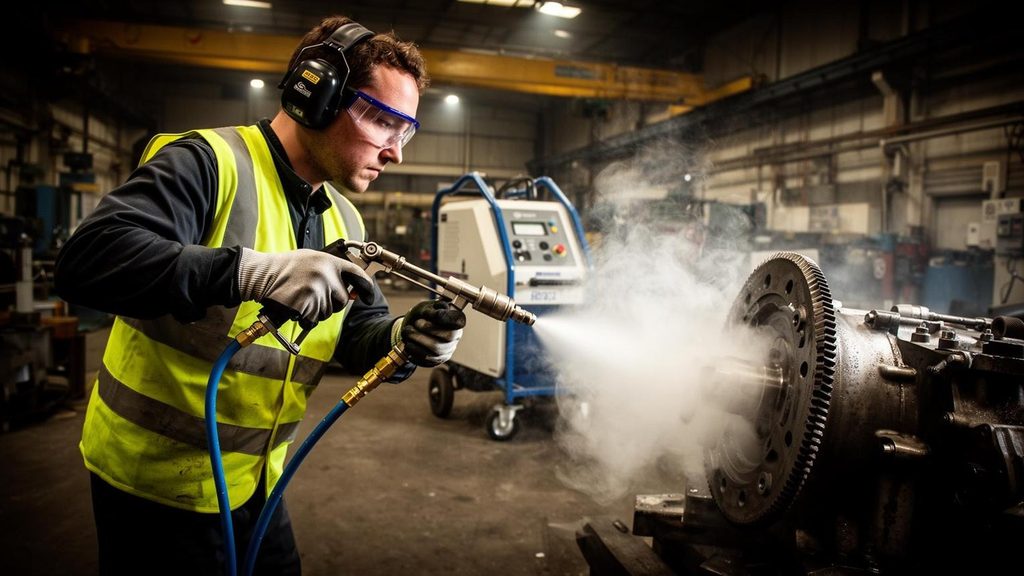
Dry ice blasting is a non-abrasive cleaning process that uses solid carbon dioxide (CO₂) pellets accelerated by compressed air. When the pellets strike a contaminated surface, the combination of impact, rapid cooling, and thermal stress helps loosen unwanted deposits.
The dry ice then sublimates, changing directly from a solid into a gas. This means the cleaning process does not leave behind spent blasting media.
Key Benefits of Dry Ice Blasting
- Non-abrasive cleaning: Helps protect delicate surfaces when the process is correctly configured.
- No secondary blasting media: Reduces cleanup associated with leftover abrasive particles.
- Reduced disassembly: Some equipment can be cleaned in place, depending on safety requirements and accessibility.
- Minimal moisture: The process does not use water as its cleaning medium.
- Versatile applications: Suitable for removing grease, oil, production residues, and certain coatings.
Dry ice blasting is commonly used in manufacturing plants, food processing facilities, electrical equipment maintenance, automotive production, and industrial machinery cleaning.
However, it is not ideal for every contaminant. Heavy rust removal, deep surface profiling, and some thick coatings may require a different technique.
What Is Sandblasting?
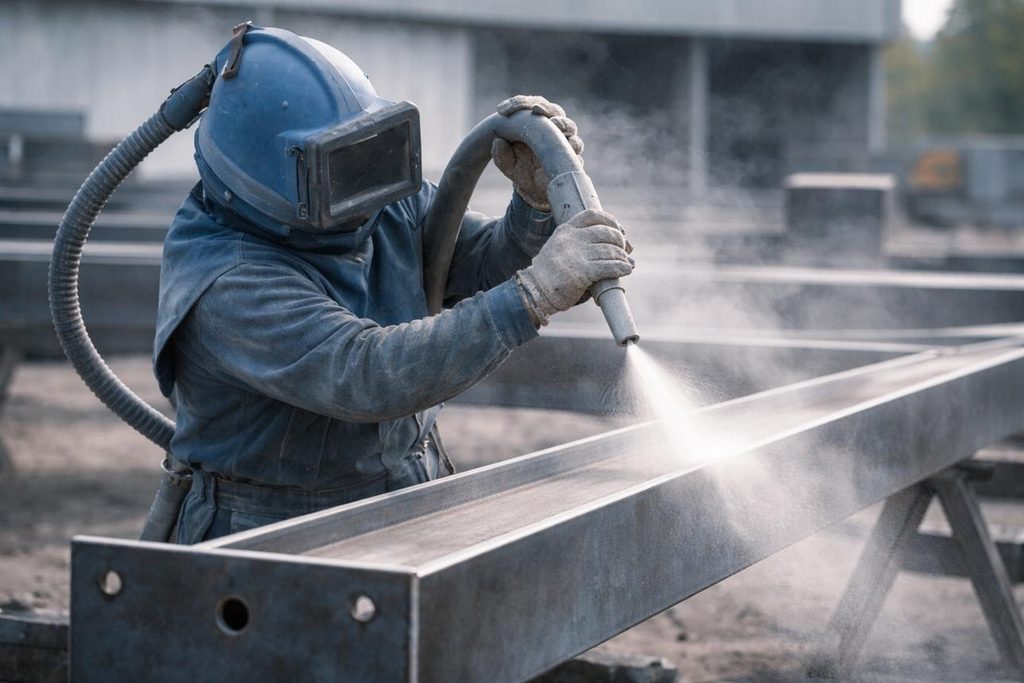
Sandblasting, commonly called abrasive blasting, uses compressed air or another propulsion system to direct abrasive particles against a surface. Despite its name, modern operations may use materials such as garnet, aluminum oxide, steel grit, or glass beads rather than silica sand.
The abrasive particles remove contaminants through mechanical impact and abrasion.
Key Benefits of Sandblasting
- Aggressive cleaning: Removes stubborn rust, scale, old paint, and other bonded materials.
- Surface preparation: Creates a surface profile that helps certain protective coatings adhere.
- Material versatility: Different abrasives can be selected for different substrates and cleaning requirements.
- Industrial applications: Widely used in metal fabrication, shipbuilding, construction, and heavy equipment restoration.
Sandblasting can be highly effective for preparing metal components before painting or coating. However, it can damage delicate surfaces, generate substantial dust, and leave spent abrasive material that must be collected and disposed of appropriately.
Dry Ice Blasting vs Sandblasting: Key Differences
The main difference is that dry ice blasting loosens contaminants without relying on conventional abrasive media, while sandblasting mechanically abrades the surface.
| Feature | Dry Ice Blasting | Sandblasting |
| Cleaning medium | Solid CO₂ pellets | Abrasive particles |
| Surface abrasion | Generally non-abrasive | Abrasive |
| Secondary media residue | No spent blasting media | Spent abrasive remains |
| Rust removal | Limited for heavy rust | Excellent with suitable abrasives |
| Surface profiling | Generally unsuitable | Effective |
| Moisture from cleaning medium | No water-based medium | Usually dry, depending on process |
| Equipment sensitivity | Suitable for many sensitive surfaces with correct settings | Requires careful abrasive and pressure selection |
| Waste management | Contaminants still require collection | Contaminants and spent abrasive require management |
| Typical applications | Machinery cleaning and residue removal | Rust removal and coating preparation |
Actual performance depends on the contaminant, substrate, equipment configuration, and operator expertise.
Which Is Better: Dry Ice Blasting or Sandblasting?
The answer depends on the cleaning objective. Neither method is universally better for every industrial application.
1. Cleaning Sensitive Industrial Equipment
Dry ice blasting is often the preferred option for cleaning machinery with complex components, electrical assemblies, or delicate surfaces that should not be scratched by abrasive media.
It can also reduce the need to dismantle equipment when cleaning in place is approved by the manufacturer and safe operating procedures.
Sandblasting is more appropriate when the surface can tolerate abrasion and aggressive cleaning is necessary.
2. Removing Rust, Paint, and Heavy Deposits
Sandblasting is generally the stronger choice for removing heavy rust, corrosion scale, and old coatings from metal surfaces. It can also create the surface profile needed for protective paints and coatings.
Dry ice blasting works well on many oils, greases, and production residues, but it should not be assumed to remove heavy corrosion or create a coating-ready surface.
3. Reducing Downtime and Cleanup
Dry ice blasting may reduce downtime because it can eliminate secondary abrasive cleanup and allow some machinery to be cleaned without extensive disassembly.
Sandblasting can require containment, dust extraction, abrasive recovery, and additional surface cleaning before equipment can return to service.
However, actual downtime depends on the cleaning area, contamination level, safety procedures, and preparation requirements.
Dry Ice Blasting vs Sandblasting Cost
When evaluating dry ice blasting vs sandblasting cost, businesses should compare the total cost of completing the job rather than focusing only on the equipment or hourly service rate.
Dry ice blasting may involve higher consumable costs because dry ice must be produced or purchased, transported, and stored appropriately. Sandblasting may have lower abrasive material costs in some applications, but containment, waste disposal, and surface preparation can increase the overall expense.
Cost Comparison Table
| Cost factor | Dry Ice Blasting | Sandblasting |
| Consumables | Dry ice supply | Abrasive media |
| Equipment investment | Specialized blasting equipment | Blasting equipment and media handling |
| Cleanup costs | Often lower for spent media | Can be higher due to abrasive recovery |
| Waste disposal | Removed contaminants still need handling | Contaminants and spent abrasive need handling |
| Labor requirements | May reduce disassembly and cleanup | Depends on containment and abrasive recovery |
| Best cost advantage | Cleaning complex equipment and reducing secondary cleanup | Large-scale rust removal and surface preparation |
Important: There is no universal price difference between the two methods. Labor rates, equipment rental, dry ice consumption, abrasive selection, and job complexity all affect the final cost.
Best Industrial Cleaning Method for Machinery
The best industrial cleaning method for machinery depends on the equipment material, type of contamination, required surface finish, and maintenance objectives.
Use dry ice blasting when:
- Machinery has sensitive or complex components.
- Oil, grease, carbon, or production residue needs to be removed.
- Secondary blasting media would create additional cleanup.
- Minimizing disassembly is important.
Use sandblasting when:
- Heavy rust or corrosion must be removed.
- Old paint or protective coatings need to be stripped.
- Metal surfaces require preparation before recoating.
- An appropriate abrasive finish or surface profile is necessary.
For some maintenance projects, a combination of cleaning methods may deliver the best results. For example, abrasive blasting may prepare a corroded metal component, while dry ice blasting may clean surrounding machinery where abrasive residue would be undesirable.
Finding the Right Dry Ice Supply
For facilities considering dry ice blasting, a reliable supply of suitable CO₂ pellets is essential for consistent cleaning performance. Working with an experienced dry ice supplier can help businesses understand supply requirements, pellet availability, and storage considerations. Confirm that the supplier can meet the specifications of your blasting equipment.
Safety and Environmental Considerations
Both methods require trained operators, appropriate personal protective equipment, and a risk assessment.
Dry ice blasting presents a carbon dioxide exposure risk because sublimating CO₂ can displace oxygen in enclosed or poorly ventilated spaces. Adequate ventilation and, where necessary, oxygen monitoring are essential. Dry ice also requires careful handling because it can cause cold burns.
Sandblasting can produce airborne dust, hazardous particles, and high noise levels. Suitable containment, ventilation, respiratory protection, and abrasive selection are critical. Silica-containing abrasives require particular caution because respirable crystalline silica can cause serious lung disease.
Neither method should be considered completely waste-free or automatically environmentally safe. Responsible contaminant collection, ventilation, and compliance with workplace safety requirements remain essential.
Frequently Asked Questions (FAQs)
1. Is dry ice blasting better than sandblasting?
Dry ice blasting is often better for removing grease, oil, and residues from sensitive machinery. Sandblasting is generally better for heavy rust removal, paint stripping, and surface preparation.
2. Which method is cheaper for industrial equipment cleaning?
The answer depends on labor, consumables, cleanup, and downtime. Dry ice blasting may reduce secondary cleanup costs, while sandblasting may be more economical for large-scale corrosion removal.
3. Can dry ice blasting remove rust?
Dry ice blasting is not generally the preferred method for removing heavy rust or creating a profile for protective coatings. Abrasive blasting is usually more effective for these applications.
4. Does dry ice blasting damage machinery?
Dry ice blasting is generally non-abrasive, but improper pressure, pellet selection, thermal shock, or equipment sensitivity can still cause damage. Always follow manufacturer guidance and test a suitable area.
5. Is sandblasting suitable for all industrial surfaces?
No. Abrasive blasting can damage soft metals, delicate components, and sensitive finishes. The abrasive type, operating pressure, and substrate must be evaluated before cleaning.
6. What should businesses consider before choosing a method?
Consider the contaminant, surface material, cleaning objective, total project cost, downtime, waste management, and safety requirements.
Conclusion
Choosing between dry ice blasting and sandblasting comes down to the condition of the equipment and the desired cleaning result.
Dry ice blasting is a strong choice for removing industrial residues while minimizing abrasion and secondary media cleanup. Sandblasting remains highly effective for heavy rust removal, coating removal, and metal surface preparation.
For businesses exploring dry ice blasting vs sandblasting for industrial equipment, the best approach is to evaluate the cleaning requirements, compare total operating costs, and select a method that balances performance, safety, and equipment protection.
If your facility needs a cleaning solution that minimizes abrasive residue, explore professional industrial dry ice cleaning options to determine whether this method suits your machinery and maintenance goals.