Introduction
Industrial equipment requires regular cleaning to maintain performance, reduce downtime, and support workplace safety. From manufacturing plants and power stations to food processing facilities and oil and gas operations, choosing the right cleaning method can significantly affect maintenance costs and productivity.
Two widely used techniques are dry ice blasting and hydro blasting. Both can remove dirt, grease, and industrial deposits, but they differ in their cleaning mechanisms, water requirements, waste generation, and suitable applications.
Understanding dry ice blasting vs hydro blasting for industrial cleaning helps businesses select a method that meets their operational needs.
In this guide, we compare both technologies, explore their benefits and limitations, and explain how to determine which solution is best for your facility.
What Is Dry Ice Blasting?
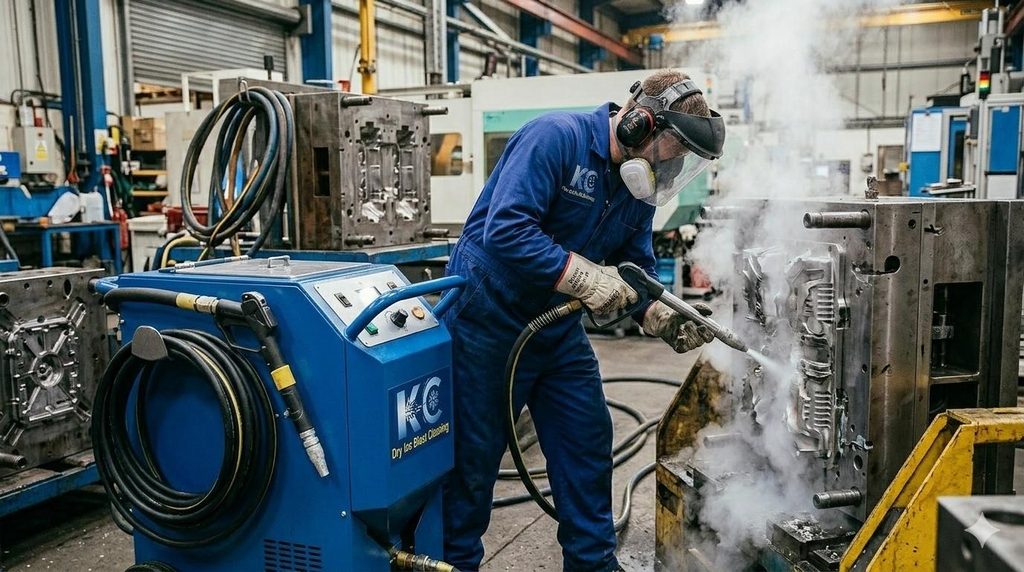
Dry ice blasting is a non-abrasive cleaning process that uses compressed air to propel solid carbon dioxide (CO₂) pellets or particles toward a contaminated surface.
The process removes unwanted materials through three main mechanisms:
- Kinetic impact: Dry ice particles strike the contamination and help loosen it.
- Thermal shock: The extremely cold particles make some contaminants brittle, helping them separate from the surface.
- Sublimation: Solid CO₂ changes directly into gas, expanding and helping dislodge the contaminant.
Unlike conventional abrasive blasting, dry ice blasting does not leave behind spent blasting media. However, the removed dirt, grease, paint, or other contaminants still need to be collected and disposed of appropriately.
Common Applications of Dry Ice Blasting
Dry ice blasting is particularly useful for:
- Cleaning electrical and electronic equipment when the manufacturer permits the method and appropriate isolation procedures are followed.
- Removing grease, oil, and production residues from machinery.
- Cleaning molds, dies, and manufacturing tools.
- Removing adhesive residues and certain coatings.
- Cleaning food processing equipment during suitable maintenance procedures.
- Removing contamination from complex surfaces and hard-to-reach areas.
Because the process introduces no cleaning water, it can be valuable when moisture control is important.
What Is Hydro Blasting?
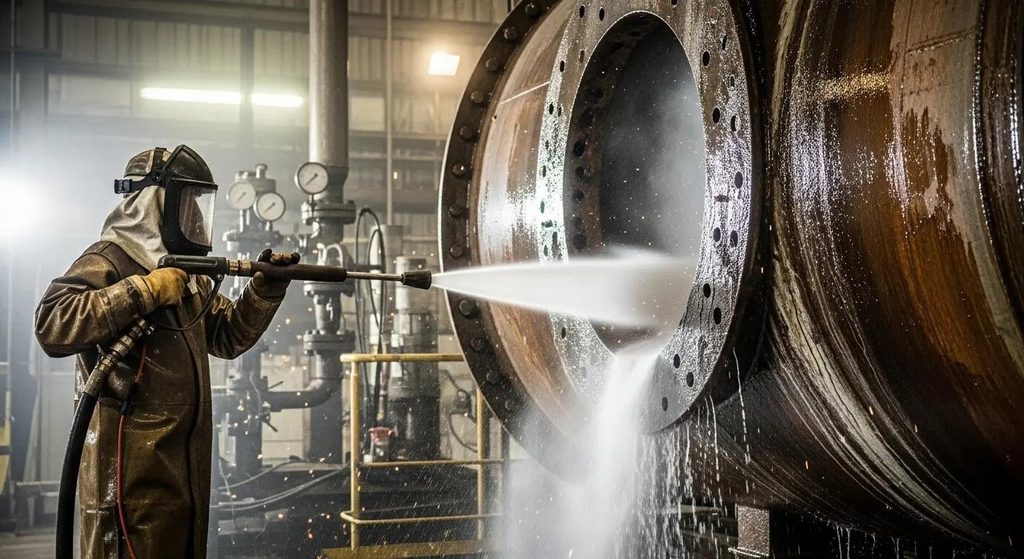
Hydro blasting, also known as high-pressure water jetting, uses pressurized water to remove deposits, scale, grease, corrosion products, and other unwanted materials from surfaces.
Depending on the equipment and application, operators can adjust the water pressure, flow rate, nozzle configuration, and cleaning technique.
Common Applications of Hydro Blasting
Hydro blasting is frequently used for:
- Removing heavy deposits from industrial vessels and tanks.
- Cleaning pipes, heat exchangers, and process equipment.
- Removing scale and certain coatings from steel surfaces.
- Cleaning concrete and industrial floors.
- Preparing surfaces for maintenance or recoating.
- Removing stubborn contamination from equipment that can tolerate water exposure.
Hydro blasting can be highly effective for demanding cleaning tasks. However, water management, corrosion risks, wastewater collection, and equipment protection must be considered before work begins.
Dry Ice Blasting vs Hydro Blasting: Key Differences
The primary difference is the cleaning medium. Dry ice blasting uses solid CO₂, while hydro blasting uses pressurized water.
| Comparison factor | Dry ice blasting | Hydro blasting |
| Cleaning medium | Solid CO₂ particles and compressed air | Pressurized water |
| Water usage | No process water added | Requires water |
| Secondary blasting media | No spent blasting media | No separate abrasive media in standard water-only systems |
| Waste management | Removed contaminants must be collected | Contaminants and wastewater may require treatment |
| Drying requirements | No process water to dry | Drying may be necessary |
| Suitable surfaces | Many machinery and mold surfaces, subject to compatibility | Water-compatible surfaces and equipment |
| Heavy deposits | Depends on contaminant and equipment | Often effective for heavy scale and stubborn deposits |
| Electrical equipment | Potentially suitable with proper isolation and safety controls | Water exposure creates additional electrical risks |
| Corrosion considerations | Avoids water-induced corrosion, but material compatibility still matters | Moisture may increase corrosion risk |
| Main operating considerations | CO₂ supply, compressed air, ventilation, and noise | Water supply, pressure control, drainage, and wastewater handling |
Important: Neither method is universally superior. Results depend on the contaminant, substrate, equipment settings, and required cleanliness standard.
Benefits of Dry Ice Blasting Over Hydro Blasting
For applications where water exposure creates operational challenges, the benefits of dry ice blasting over hydro blasting can be significant.
1. No Added Cleaning Water
Dry ice blasting does not introduce process water to the equipment being cleaned. This can reduce moisture-related concerns in suitable applications, especially around machinery with sensitive components.
It does not mean all electrical equipment can be cleaned while energized. Isolation and manufacturer-approved procedures remain essential.
2. Reduced Secondary Waste
Dry ice sublimates into carbon dioxide gas rather than remaining as solid blasting debris. This eliminates the need to collect spent dry ice media.
However, contaminants removed during cleaning still generate waste and may require special handling.
3. Less Downtime in Suitable Applications
Some equipment can be cleaned without dismantling as many components or waiting for water to evaporate. This may shorten maintenance windows and improve operational efficiency.
Actual downtime savings depend on equipment accessibility, contamination severity, and preparation requirements.
4. Non-Abrasive Cleaning
Dry ice blasting is generally non-abrasive when correctly configured. It can help clean delicate molds, machinery, and complex surfaces without the mechanical abrasion associated with some conventional blasting methods.
Surface testing is still advisable because impact, thermal shock, and equipment settings can affect certain materials.
5. Cleaning Complex Equipment
Dry ice particles can reach grooves, recesses, and intricate equipment features that are difficult to clean manually. This makes the technology useful in manufacturing and maintenance environments where precision matters.
When Is Hydro Blasting the Better Choice?
Despite the advantages of dry ice blasting, hydro blasting remains the better option for many industrial cleaning projects.
1. Removing Heavy Scale and Deposits
High-pressure water can deliver substantial cleaning force, making hydro blasting suitable for certain stubborn deposits, mineral scale, and thick accumulations.
2. Cleaning Pipes and Process Equipment
Hydro blasting is widely used for cleaning internal pipe surfaces, heat exchangers, and vessels, provided the system can safely accommodate the water jetting process.
3. Preparing Surfaces for Maintenance
Some maintenance and coating projects require a specific level of surface cleanliness or preparation profile. Hydro blasting may be appropriate when the project specification and substrate support its use.
4. Managing Water-Compatible Contamination
When a facility has suitable drainage, wastewater treatment, and drying procedures, hydro blasting can be a practical and cost-effective choice for large-scale cleaning.
Which Is Better: Dry Ice Blasting or Hydro Blasting?
The answer to which is better dry ice blasting or hydro blasting depends on the cleaning objective rather than the technology alone.
Use dry ice blasting when moisture control, minimal secondary media, and non-abrasive cleaning are priorities.
Consider hydro blasting when heavy deposits, water-compatible surfaces, or demanding cleaning requirements make high-pressure water more suitable.
The following decision guide can help industrial maintenance teams choose.
| Cleaning requirement | Preferred starting option |
| Cleaning without introducing process water | Dry ice blasting |
| Cleaning suitable electrical equipment after proper isolation | Dry ice blasting may be suitable |
| Removing certain heavy mineral deposits | Hydro blasting |
| Cleaning intricate molds and machinery | Dry ice blasting may be suitable |
| Cleaning water-compatible tanks and pipes | Hydro blasting may be suitable |
| Reducing spent blasting media | Dry ice blasting |
| Meeting a specified surface preparation standard | Whichever method meets the specification |
A professional assessment should consider cleaning performance, equipment compatibility, worker safety, waste handling, and total operating cost before the final method is selected.
Safety and Environmental Considerations
Both cleaning methods require trained operators, suitable protective equipment, and a documented risk assessment.
Dry ice blasting can create high noise levels and release CO₂ gas, which may displace oxygen in enclosed or poorly ventilated spaces. Appropriate ventilation, atmospheric monitoring where required, and respiratory and hearing protection measures are essential.
Hydro blasting presents high-pressure injection hazards that can cause severe injuries. Operators must use pressure-rated equipment, exclusion zones, suitable protective equipment, and established water jetting safety procedures.
Neither method is automatically environmentally harmless. Dry ice blasting relies on CO₂, while hydro blasting may produce contaminated wastewater. Businesses should evaluate the complete process, including energy use, consumables, waste management, and local environmental requirements.
Choosing the Right Dry Ice Blasting Partner
Selecting the right equipment and service provider is essential for achieving consistent cleaning results. Look for a supplier that understands industrial applications, provides suitable equipment recommendations, and can explain operating requirements and safety procedures.
If your facility needs specialized cleaning equipment or consumables, explore dry ice blasting solutions suited to your application.
For businesses sourcing dry ice locally, working with a reliable dry ice supplier in Saudi Arabia can also help support supply planning and maintenance schedules.
Before investing, consider conducting a controlled cleaning trial. Comparing results on a representative surface can help determine cleaning effectiveness, material compatibility, and the practical cost of each method.
Conclusion
Dry ice blasting and hydro blasting both offer valuable solutions for industrial maintenance, but their strengths differ. Dry ice blasting is attractive when avoiding added water, minimizing secondary blasting media, and cleaning complex equipment are priorities. Hydro blasting is often effective for heavy deposits and water-compatible industrial surfaces.
The best approach to dry ice blasting vs hydro blasting is to match the technology to the contamination, surface material, safety requirements, and cleaning target. A careful assessment and practical trial can help businesses make an informed decision and achieve reliable maintenance results.
Frequently Asked Questions (FAQs)
1. What is the main difference between dry ice blasting and hydro blasting?
Dry ice blasting uses solid carbon dioxide particles propelled by compressed air, while hydro blasting uses high-pressure water. Dry ice sublimates after impact, whereas hydro blasting introduces water that may require collection and drying.
2. Is dry ice blasting better than hydro blasting for industrial cleaning?
Dry ice blasting may be better for moisture-sensitive equipment, intricate machinery, and applications where reducing secondary blasting media is important. Hydro blasting may be better for heavy deposits and surfaces that tolerate water.
3. Can dry ice blasting remove grease and oil?
Yes. Dry ice blasting can remove many types of grease and oil from industrial surfaces. Results depend on the contaminant, its thickness, surface temperature, and equipment settings.
4. Does hydro blasting damage industrial equipment?
It can if the pressure, nozzle, or technique is unsuitable for the surface. Excessive pressure may damage coatings, seals, or softer materials. Proper equipment selection and trained operation help reduce these risks.
5. Which method is more cost-effective?
The total cost depends on equipment, labor, consumables, cleaning speed, downtime, waste handling, and drying requirements. Dry ice blasting may reduce some cleanup costs, while hydro blasting may be more economical for certain heavy-duty cleaning applications.
6. Is dry ice blasting environmentally friendly?
It reduces secondary blasting media waste and avoids adding process water. However, it consumes energy and releases CO₂ during use. Its overall environmental impact depends on the source of the CO₂, equipment efficiency, and the complete cleaning process.
7. How can businesses choose the right industrial cleaning method?
Evaluate the type of contamination, surface material, cleanliness requirements, equipment sensitivity, safety risks, and total operating costs. A controlled cleaning trial can help establish which method performs best.